
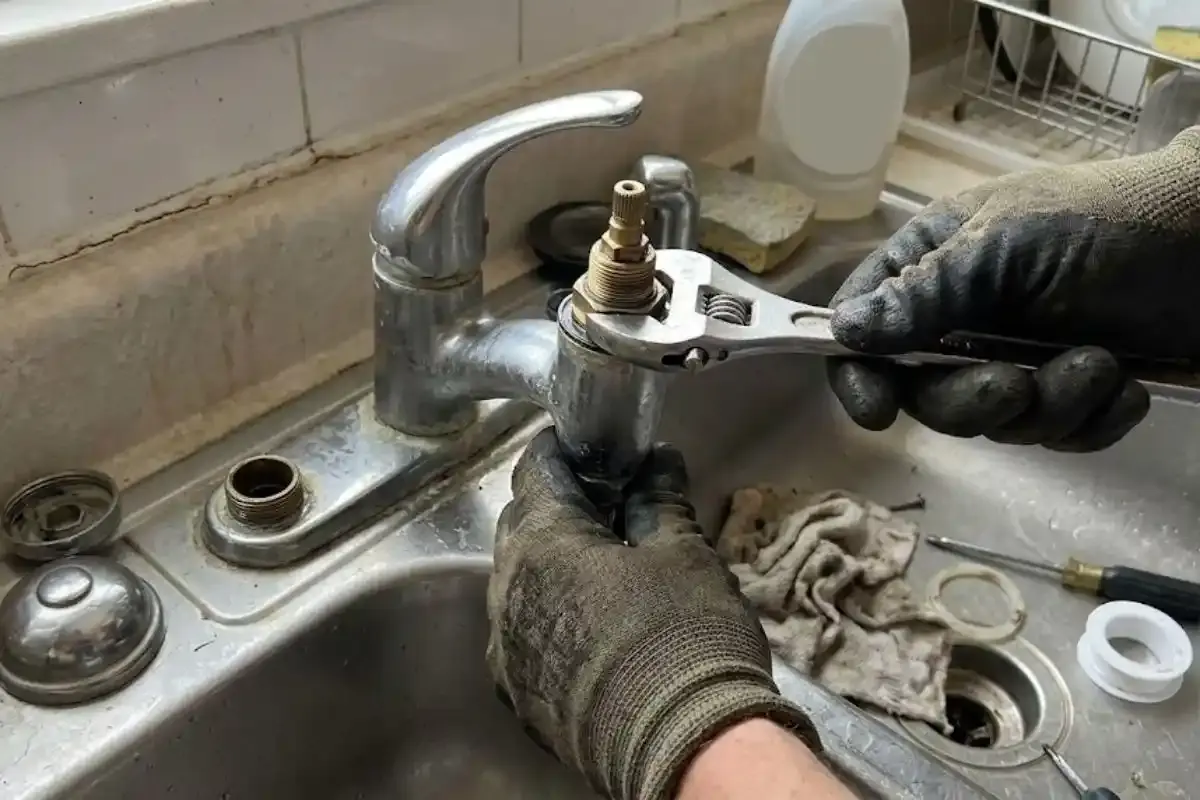
A dripping kitchen faucet wastes water and keeps you awake. The fix depends on the type of faucet, because each design seals in a different way. Once you know the type, the likely culprit is clear and the repair is often a single part. This guide walks through the four common designs, what to look for and when to call a plumber.
Identify the faucet type first
| Type | How to recognize it | What usually fails |
|---|---|---|
| Compression | Two handles that screw down | Rubber washer and seat |
| Cartridge | One or two handles, smooth motion | Cartridge or its O-rings |
| Ball | Single handle over a rounded cap | Springs, seals and cam |
| Ceramic disk | Single handle, a quarter-turn feel | Disk seals or the cylinder |
If the faucet drips from the spout, the internal seal is failing. If it leaks around the handle or the base, an O-ring or packing is the likely cause. If water appears under the sink, check the supply lines and shutoff valves before you blame the faucet.
Step-by-step: replacing a cartridge or washer
- Turn off the shutoff valves under the sink, then open the faucet to release pressure.
- Plug the drain so small parts cannot fall in, and lay down a towel.
- Remove the handle by prying off the cap and unscrewing the set screw.
- Take out the retaining nut or clip, and pull the cartridge or stem.
- Compare the old part to a new one at the store, and replace O-rings and seats along with it.
- Reassemble in reverse order, turn the water on slowly, and check for leaks.
Rather skip the toolbox?
Call and we will diagnose the faucet and repair it, or replace it if it is not worth saving.
Low flow and sputtering are scale, not drips
If the stream is weak or splits, the aerator at the spout tip is probably clogged. Unscrew it, soak it in white vinegar for an hour and rinse. White crust inside the aerator and around the base is mineral scale, which is common where the water is hard. A faucet that sees scale every month is a sign to look at the water, not just the fixture.
Haltom City local note
According to the city's 2025 water quality report, Haltom City's tap water is 108 to 150 parts per million hard, about 6 to 9 grains per gallon. That is the kind of water that leaves white scale on aerators and inside cartridges, which is why a cartridge that sticks or an aerator that clogs is a common call here.
The city's winter weather guide advises letting one or two faucets trickle on a hard-freeze night to protect pipes. A drip is not always waste in that situation, though a faucet that drips in warm weather deserves a repair.
When a replacement beats a repair
- The finish is peeling or the body is corroded
- The faucet is a discontinued model with no parts
- The faucet has been repaired several times in a short period
- You want a pull-down sprayer or a different style
- The shutoff valves under the sink do not close and need replacing anyway
Replacing the shutoff valves at the same time is a smart move. Old valves that do not close force you to shut the house main every time something leaks.
Drips that are not from the spout
Pull-down and pull-out kitchen faucets add parts that can leak on their own. The diverter that switches between stream and spray can stick and send water out of the wrong opening. The hose that runs to the spray head can crack where it bends under the sink, and the weight on the hose can wear the fitting at the faucet base. If water drips from the sprayer head after you shut the faucet off, the diverter or the spray head's check valve is the likely cause, not the cartridge.
Take a close look at where the faucet meets the sink. A film of water at the base usually means a worn base gasket or O-ring on the spout body. If the spout wobbles, the mounting nut under the sink has loosened. Tightening it is a two-minute job that often ends the leak.
Parts worth having before you start
- A cartridge or stem matched to the faucet brand and model, which is usually printed on a tag or under the handle
- A small set of O-rings and a tube of plumber's grease
- An adjustable wrench and a set of hex keys
- White vinegar for the aerator, and a small brush
- A spare braided supply line, since old lines tend to fail when disturbed
If you cannot identify the brand, take the old cartridge to a plumbing supply counter. Matching by sight is the most reliable method, because many cartridges look alike but differ by a few millimeters.
Leaks under the sink
If the cabinet is wet, find where the water is coming from before you tighten anything. Run a dry paper towel along the supply lines, the faucet base and the drain. A cracked supply line, a loose compression nut or a failed drain connection can mimic a faucet leak. If it keeps returning after the repair, there may be a leak behind the wall, and a leak detection visit can confirm it.
We handle the full repair at faucet repair, and a jammed disposal under the same sink is covered at garbage disposal repair. We work in Haltom City and nearby North Richland Hills, and the rest of our service area is listed on its own page.
Faucet won't stop dripping?
Call any hour. We answer 24/7.
Kitchen faucet questions
A worn cartridge, washer, seat or O-ring lets water past. Matching the part to your faucet type fixes it.
A clogged aerator is the usual cause. Unscrew it, soak it in vinegar and rinse.
A slow drip can waste many gallons a month, enough to notice on a bill.
Scale can stop a cartridge from seating. Haltom City water runs around 6 to 9 grains per gallon, so scale is a common cause.
The city's winter weather guide recommends letting one or two faucets trickle on a hard-freeze night. Fix any drip once the weather warms.