
If the glass shower door clouds over, white crust builds on the faucet, or the water tastes of chlorine, the water supply is the cause, and a treatment system may be the answer. Call (817) 601-6266 at any hour to talk through your options, and we will begin with the water itself, not a product.
What Haltom City water actually contains
The city's 2025 water quality report says Haltom City's water is surface water, with treatment data reported for Fort Worth and a source in the Tarrant Regional Water District system. Hardness runs from 108 to 150 parts per million as calcium carbonate, which is roughly 6 to 9 grains per gallon. That sits in the moderately hard to hard range. The disinfectant is chloramine, which averaged 2.63 parts per million in 2025, with readings from 0.7 to 4.0.
Those two numbers explain most complaints. Hardness leaves scale on fixtures and inside water heaters. Chloramine is the reason for the pool-water taste some people notice. They are different problems and need different equipment.
| What you notice | Cause | What helps |
|---|---|---|
| White scale on faucets and glass | Hardness, 6 to 9 grains per gallon | Salt-based softener |
| Spots on dishes | Dissolved minerals | Softener, rinse aid |
| Chlorine or pool taste | Chloramine disinfectant | Catalytic carbon filter, not a standard softener |
| Sediment or cloudy water | Particles from pipes or the system | Sediment filter |
| Short life of water heater | Scale buildup on the tank and elements | Softener, regular flushing |
Softener or filter, and why you might need both
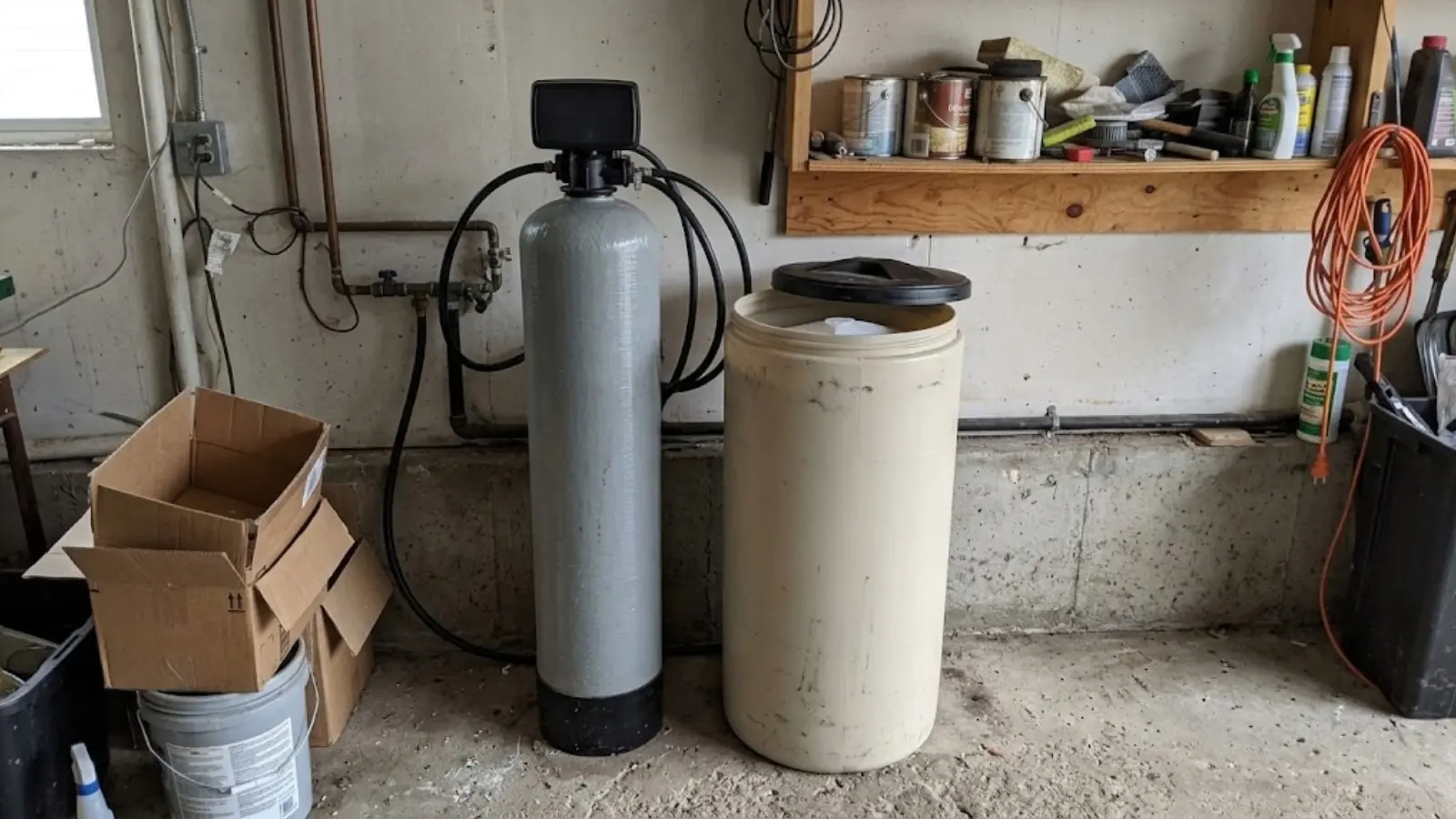
A salt-based softener swaps calcium and magnesium for sodium, which prevents scale. It does not remove chloramine. A catalytic carbon filter reduces chloramine and improves taste but does not soften. Many homes in water like this use a softener for the whole house and a carbon filter or a small reverse osmosis unit at the kitchen tap. People on a low-sodium diet should ask their doctor about softened drinking water, and a bypass tap for cold drinking water is an option.
Salt-free conditioners are sold as alternatives. They change how scale forms rather than removing the hardness, and results vary, so we describe them honestly as a lighter option, not an equal one.
Sizing and installing a softener
A softener is sized by the number of people, the hardness and how often you want it to regenerate. With 6 to 9 grains per gallon, a typical household does not need an oversized tank. We install it on the main supply after the outdoor spigots, with a bypass valve, a drain line with an air gap, and a power supply for the controller.
Not sure which system fits?
Call and tell us what you notice at the tap. We will tell you whether treatment makes sense.
Protecting the water heater
Hard water shortens the life of a tank water heater and clogs a tankless one. Softened water protects both. If you are weighing a tankless water heater, treat the water first. If your tank is nearing the end, consider water heater replacement along with a softener, so the new unit starts in good conditions.
What affects the price
- System typeA softener, carbon filter and RO unit differ in cost.
- CapacityLarger tanks cost more but regenerate less often.
- Plumbing changesA bypass, drain and electrical outlet may need to be added.
- Water testLab testing adds a small cost but sets the right size.
- Salt and maintenanceSalt refills and filter changes are ongoing costs.
Insurance does not cover water treatment equipment. Want your real number? Call (817) 601-6266.
Water treatment questions
The city's 2025 water quality report lists hardness of 108 to 150 parts per million, roughly 6 to 9 grains per gallon.
No. A catalytic carbon filter reduces chloramine, and a softener addresses hardness.
It contains added sodium, which matters for low-sodium diets. Ask your doctor, and consider a bypass tap for drinking water.
They change how scale forms but do not remove hardness. Results vary.
It depends on hardness, water use and the model. Most owners add salt every month or two.