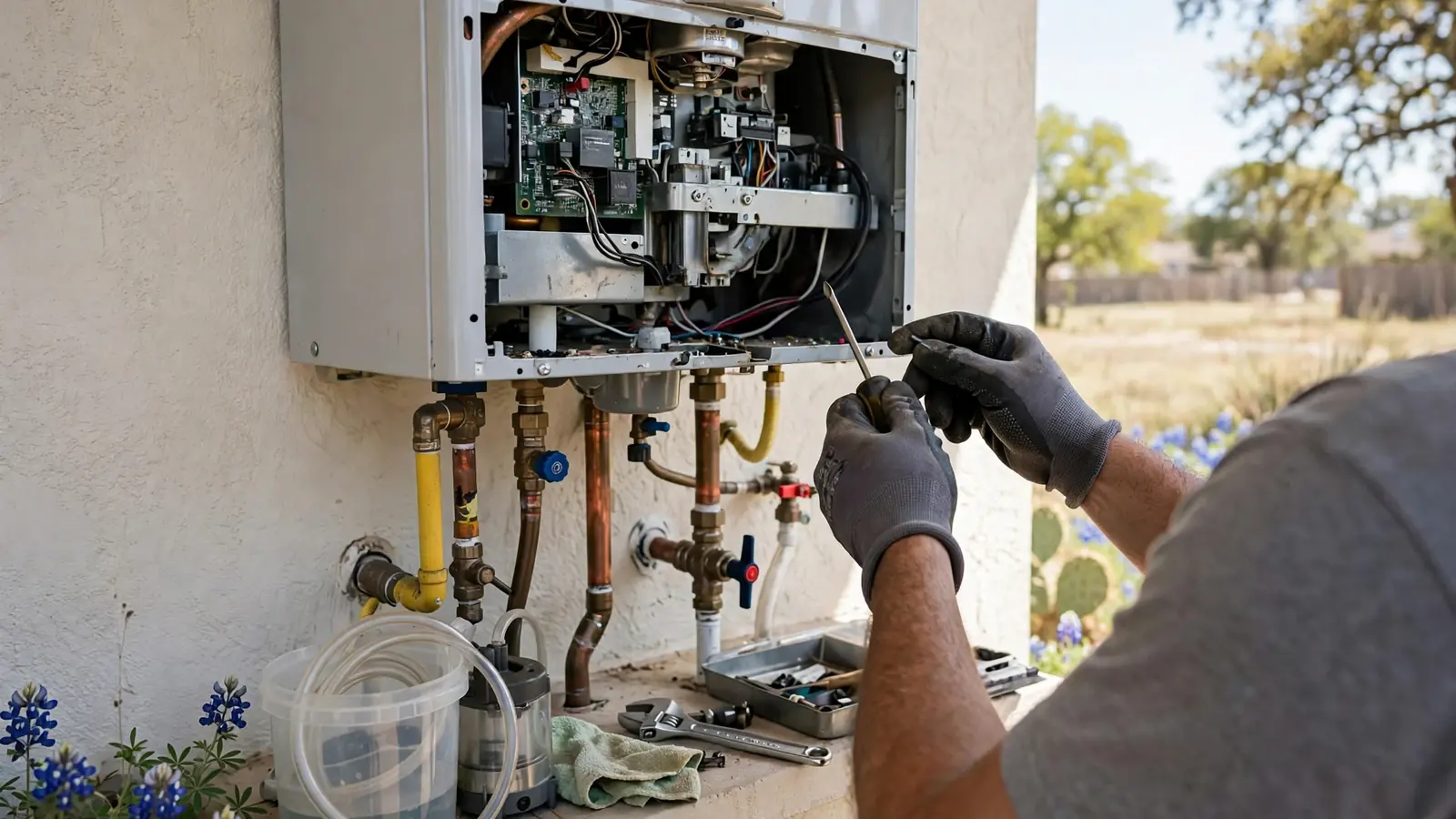
A tankless water heater heats water as it flows instead of keeping forty or fifty gallons hot all day. In a house with steady use that can save energy and space, but the unit needs gas piping sized for it, correct venting and regular care. Call (817) 601-6266 at any hour to talk through whether your home suits one.
What hard water does to a tankless heater
The Haltom City 2025 water quality report lists hardness of 108 to 150 parts per million, roughly 6 to 9 grains per gallon. Tankless heat exchangers have narrow passages, so scale builds up faster than it does on a tank floor. Left alone it cuts flow, raises temperatures and triggers error codes. Installing isolation valves at the start and flushing the unit with a descaling solution about once a year keeps it healthy. A softener upstream cuts the problem further.
The city also reports chloramine as its disinfectant, with a 2025 average of 2.63 parts per million. Chloramine does not harm a tankless heater, but carbon filtration will matter if the household wants to remove it from drinking water.
Tank or tankless: what actually differs
| Consideration | Tank heater | Tankless heater |
|---|---|---|
| Hot water supply | Limited by tank size, then recovery | Continuous, limited by flow rate |
| Gas supply | Standard line is usually enough | Often needs a larger line and meter capacity |
| Venting | Standard draft or direct vent | Stainless, PVC or CPVC depending on model |
| Maintenance | Annual flush and anode check | Annual descaling flush, more critical in hard water |
| Space | Floor space for a tank | Wall mounted, small footprint |
| Cost to install | Lower | Higher up front |
What an install requires
Most tankless units need a bigger gas line than the old tank, so we measure the run and the capacity at the meter. Venting is the next issue, since many units use sealed vent pipe through the wall or roof. Condensing models also need a drain for acidic condensate. Electric models need substantial amperage on a dedicated circuit, which an electrician may need to supply.
Permit and inspection rules apply as they do for any plumbing work. Haltom City has adopted the 2021 International Plumbing Code, contractors must be registered with the city to pull permits, and inspections are required for permitted work. Ask the city building department whether your specific swap needs a permit.
Curious if tankless fits your house?
Call and tell us your gas line size, bathrooms and household. We will give you an honest recommendation.
Tankless repair and descaling
Common service calls include error codes from scale, no hot water because a flow sensor is dirty, temperature that swings, and ignition faults. Descaling is the routine fix. We connect a pump to the isolation valves, circulate a descaling solution, rinse and test. Units installed without isolation valves can have them added, which makes every future flush easier.
When one tankless unit cannot keep up, a second can be added in parallel. When the heat exchanger itself is damaged or the unit is past its life, we replace it.
What affects the price
- Unit size and fuelOutput capacity and gas versus electric change the equipment cost.
- Gas line and meterUpsizing a line adds pipe and labor.
- Venting routeLonger or more complex runs cost more.
- Water treatmentAdding isolation valves or a softener adds equipment.
- Permit and inspectionWhen a permit applies, the inspection is part of the job.
Insurance does not usually pay for a water heater upgrade by choice. Want your real number? Call (817) 601-6266.
If you decide a tank suits you better, water heater installation covers sizing and code. A softener is often the best companion to a tankless unit, and water softener and filtration explains how it is sized in our water.
What to do if you smell gas near a heater
- Do not use switches, lighters or phones inside the house
- Leave the house and call your gas utility or 911 from outside
- Do not go back in until you have been told it is safe
What to do if you smell gas near a heater
- Do not use switches, lighters or phones inside the house
- Leave the house and call your gas utility or 911 from outside
- Do not go back in until you have been told it is safe
Tankless water heater questions
It can. At 6 to 9 grains per gallon, scale builds on the heat exchanger. Annual descaling and isolation valves keep it working, and a softener helps.
Often yes. Tankless units demand a lot of gas when running, so the line and meter capacity are checked before quoting.
About once a year in hard water, sometimes more often if the unit shows scale error codes.
Low flow, a dirty sensor, scale or a gas supply problem can all cause it. A diagnosis finds which.
Usually not both on the same plumbing, but a point-of-use unit can serve one far fixture. We can discuss it when we see the house.