
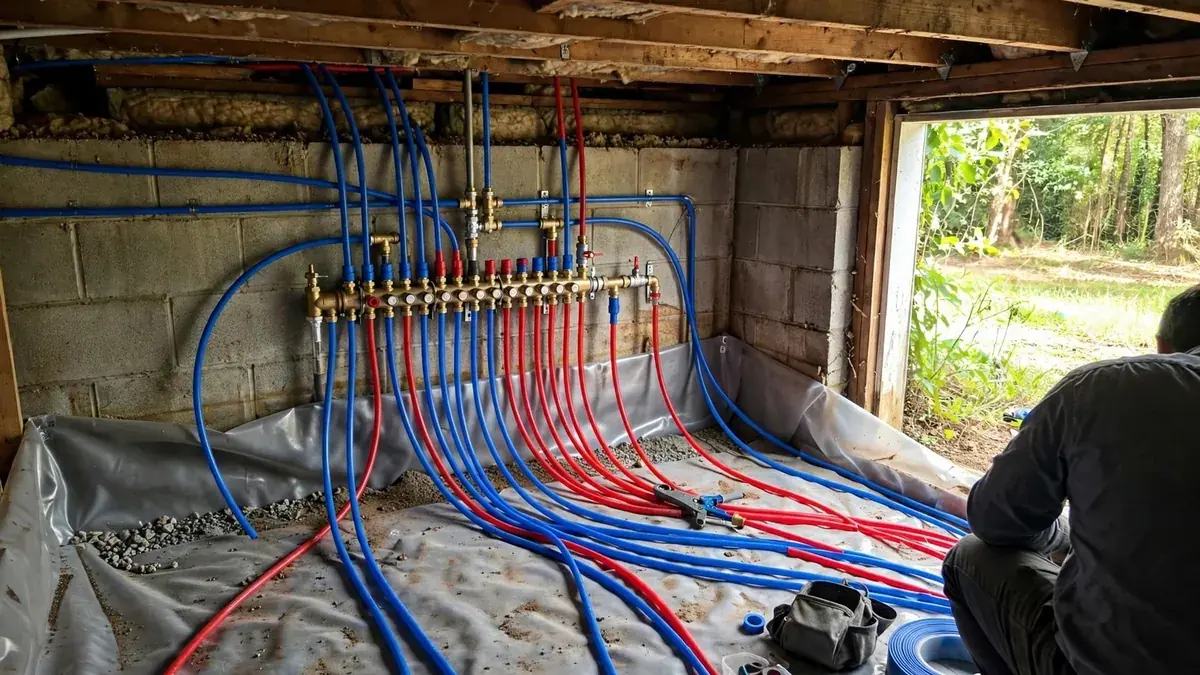
Plastic pipe took over residential plumbing because it does not rust, it is light and it goes in quickly. But the word plastic covers several very different products. Some belong on the supply side, carrying pressurized drinking water. Others belong on the drain side, carrying wastewater by gravity. A few were mistakes. Knowing which you have in your Haltom City house helps you decide what to repair and what to replace.
The plastic pipes you will meet
| Pipe | Used for | Strengths | Watch for |
|---|---|---|---|
| PEX (cross-linked polyethylene) | Hot and cold supply lines | Flexible, handles freezing better than rigid pipe, fast to install | Sunlight damage, certain chemicals, crimp or fitting problems |
| CPVC | Hot and cold supply lines | Rigid, handles hot water, widely used | Becomes brittle with age and heat, can crack at fittings |
| PVC | Drains, vents, cold supply and some irrigation | Inexpensive, long lasting | Not for hot water, needs correct solvent cement |
| ABS | Drain and vent lines | Strong, easy to join | Black, can discolor in sunlight |
| Polybutylene | Supply lines in some older homes | Once used widely | Known to fail, replacement recommended |
Supply side and drain side are different worlds
Supply pipes hold water under pressure all day. If a fitting lets go, water sprays until someone shuts the main. Drain pipes only carry water when you use a fixture and are open to air. Supply failures cause the dramatic floods. Drain failures cause slow rot and smells. The pipe types and the fittings are chosen with that in mind, and mixing them is a mistake.
Not sure what is in your walls?
Call and we can identify the material and tell you what it means.
Polybutylene: the one to know about
Polybutylene was a gray or blue plastic supply pipe installed in many American homes from the late 1970s into the 1990s. It was found to deteriorate from the inside, particularly where it met certain fittings and in water treated with oxidizers, and it fails without warning. If you see gray or blue flexible plastic pipe near the water heater or where the line enters the house, plan to replace it. That is a repiping project, not a repair.
CPVC and age
CPVC is tan or cream colored, rigid and usually found in houses built since the 1980s. It works well when installed with the right cement and primer, but it grows brittle with age and heat. A crack at a fitting can look like a burst pipe from nowhere. If a CPVC house has a failed section, a plumber will inspect the rest, because brittleness tends to show up in several places.
Haltom City local note
Haltom City has adopted the 2021 International Plumbing Code (IPC), which sets which pipe materials are accepted for each use. Contractors who pull permits must be registered with the city, and permitted plumbing work is inspected, including rough-in before the walls are closed. The city's permit form lists a minimum of 1 inch for a water service line and 4 inches for a building sewer.
Much of the housing here dates from the decades after the 1950s growth boom, when the population went from 5,760 to 23,133 in ten years according to the Handbook of Texas. Original supply lines in the oldest houses are commonly galvanized steel, with plastic added during later repairs, so many houses carry a patchwork of materials.
Mixing materials safely
Houses with a patchwork of pipe materials need the correct transition fittings. Copper to galvanized without a dielectric union corrodes at the joint. PEX to copper needs the right crimp or expansion fitting. CPVC to PVC needs a transition coupling. A leak at a transition is a common cause of a repeat call, and the fix is the right fitting, not more tape or glue.
- Never use PVC cement on CPVC, or the other way around
- Protect PEX from sunlight and do not run it near a flue or hot pipe
- Use sleeves where pipe passes through framing or concrete
- Support horizontal runs at the spacing the code requires
- Pressure test new work before closing walls
Freeze protection in North Texas
Haltom City's winter guide recommends insulating exposed pipes, including those under raised homes. PEX handles a freeze better than rigid pipe because it can expand, but it can still fail at fittings. CPVC and copper can split. In February 2021, Fort Worth saw more than 700 water main breaks in the winter storm, according to a Texas Standard report from a year later, a reminder that cold snaps here are rare enough to catch houses unprepared.
When plastic pipe needs a plumber
A pinhole spray, a fitting that weeps or a pipe that shows green or white crust at a joint deserves an inspection. A sudden drop in pressure might signal a hidden leak, and leak detection finds it without opening the wall. When one section fails, burst pipe repair fixes it. We serve Haltom City and neighboring North Richland Hills, and our service area page lists the rest.
Pipe problem?
Call any hour. We answer 24/7.
Plastic pipe questions
They are different. PEX is flexible and tolerates freezing better. Copper is traditional and long lasting. Both work, and the right choice depends on the house.
It is gray or blue flexible plastic, often with a code like PB2110 printed on it. Look near the water heater or where the line enters the house.
Yes, it is rated for it. It becomes brittle over time, so older systems need watching.
The city has adopted the 2021 International Plumbing Code (IPC), and permitted work is inspected by the city, with contractors registered to pull permits.
No. PVC is not rated for hot water. Use CPVC, PEX or copper.