
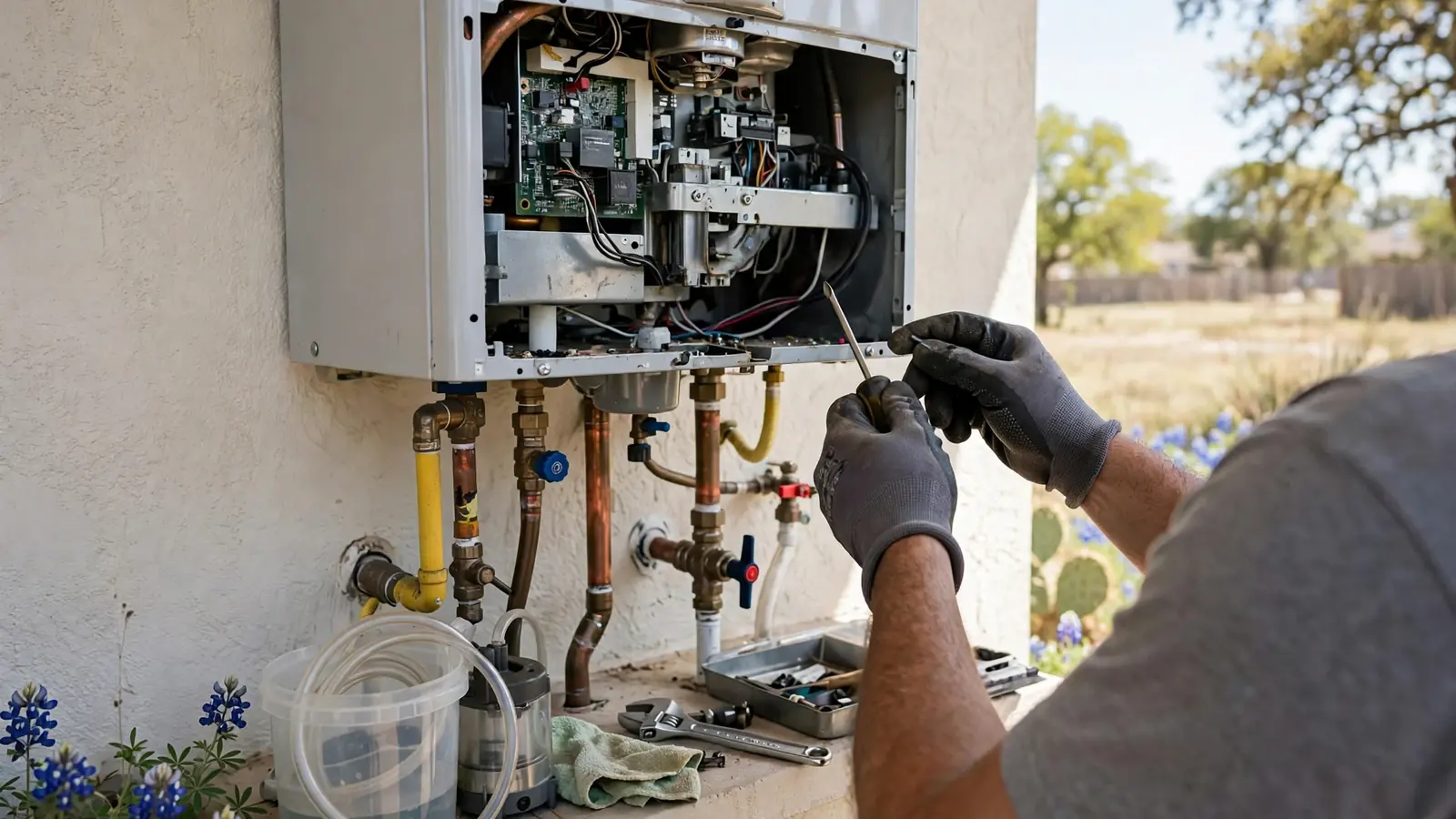
A tankless water heater heats water on demand and can deliver hot water for as long as the tap is open. That sounds simple, and the use is. The installation is not, because a unit that heats a fast stream of cold water needs a lot of energy delivered at once. This guide covers what the install requires, in the order a plumber checks it.
Step one: how much hot water do you need at once
Tankless units are rated by flow in gallons per minute at a given temperature rise. The question is how many fixtures run at the same time. A shower, a dishwasher and a washing machine together demand more than a single bathroom. The temperature rise depends on how cold the incoming water is, which is lower in winter. A unit sized for summer may fall short in January.
| Requirement | Typical need | Who handles it |
|---|---|---|
| Gas line | Larger line and meter capacity than a tank heater | Plumber, with the gas utility if the meter needs changing |
| Venting | Sealed vent through a wall or roof, stainless or plastic by model | Plumber or mechanical installer |
| Condensate drain | Needed for condensing models | Plumber |
| Electric | Power for the controls, or a large circuit for electric models | Electrician for new circuits |
| Water | Isolation valves, pressure and flow check | Plumber |
| Permit | Depends on the city and the scope | Registered contractor |
Want a site visit?
Call and we will check the gas line, the vent route and the space.
Gas supply
Most tankless heaters need much more gas than a tank unit, because they are firing at full power while a tap is open. The existing line may be too small, or the run may be long. We measure the line, count the other gas appliances and check the meter's capacity. If the line must be upsized, that is part of the job. A line that is too small causes the unit to shut down under load, which is a common complaint with poorly planned installs.
Venting
Venting is the second big question. A tankless unit that is mounted on the wall needs a vent path for exhaust and, in many models, a separate path for combustion air. Condensing units can use plastic pipe because the exhaust is cooler, and they need a drain for the acidic condensate. Non-condensing units need stainless steel venting. Wall and roof penetrations must be sealed and clear of windows and openings.
Haltom City local note
The city's 2025 water quality report lists hardness between 108 and 150 parts per million, roughly 6 to 9 grains per gallon. Tankless heat exchangers have narrow passages, so scale is the main long-term issue. Isolation valves on the supply and return make annual flushing simple, and a softener upstream prolongs the life of the unit.
Haltom City has adopted the 2021 International Plumbing Code (IPC), contractors must be registered with the city to pull permits and permitted work is inspected. Gas and venting work follows the fuel gas and mechanical codes the city has adopted, so ask the building department which editions apply to your project.
Water treatment and maintenance
- Install isolation valves so the heat exchanger can be flushed
- Plan to descale about once a year in hard water
- Consider a softener to prevent scale at the source
- Keep the air filter and intake clean on units that have them
- Test the pressure and flow when the unit is installed, so you know the baseline
A tankless heater that is neglected in hard water tends to lose capacity, show error codes and eventually fail early. A flush takes under an hour and a bit of descaling solution.
A realistic timeline
A straightforward swap of a tank for a tankless unit takes most of a day, and longer if the gas line has to be upsized or a new vent run is needed. A unit that replaces an older tankless of the same type can go in more quickly. If a permit applies, the inspection adds a day that depends on the city's schedule, and Haltom City's inspection hours run Monday through Thursday. Plan for hot water to be off for part of the day, and ask the plumber to tell you when.
What makes the price climb
The unit itself is only part of the bill. Gas piping, venting, a condensate drain, an electrician for a new circuit, isolation valves and the permit all add to it. Ask for a quote that lists each one so you can compare installers on an equal footing. A bare equipment price that leaves these out will look cheaper until the invoice arrives.
Questions to ask any installer
- What size is the gas line, and does it need upsizing?
- How will it be vented, and where does the exhaust go?
- Does the quote include isolation valves and a condensate drain?
- Who pulls the permit, and when is the inspection?
- What does the warranty cover, and who services the unit?
Next steps
Tankless water heater service covers repair, descaling and replacement. If you are comparing it with a tank, water heater installation explains the tank side. We serve Haltom City and neighboring North Richland Hills, and our service area page lists the rest.
Considering tankless?
Call any hour. We answer 24/7.
Tankless installation questions
Often yes. The unit fires at high output, so the line and meter must supply enough gas.
Through a sealed vent to the outside, with stainless or plastic pipe depending on the model.
Ask the building department. Contractors must be registered with the city to pull permits, and permitted work is inspected.
Hard water leaves scale in the heat exchanger. Haltom City water runs about 6 to 9 grains per gallon.
Sometimes. Venting, gas and clearances decide it.